Market Scale Analysis of Flexible Circuit Board (FPC) for Automobile in the World
Flexible Printed Circuit (FPC), also known as Flexible Board, Flexible circuit Board or Flexible printed circuit Board, is divided into single-sided flexible PCB, double-sided flexible PCB, multilayer flexible PCB and rigid-flexible PCB board. Flexible circuit boards are light and flexible, which can meet the development trend of electronic products toward miniaturization, thinning and wearability, especially their flexibility, winding and folding characteristics. Flexible circuit boards can move and expand arbitrarily in three-dimensional space to facilitate the three-dimensional assembly of electronic products.
Because of the great advantages of FPC, such as light, thin and flexible, the use of FPC is also increasing. From communications, consumer electronics, automotive electronics, industrial control, medical treatment, to military, aerospace, FPC is almost everywhere. Among them, automotive electronics is expected to replace mobile phones in the future and become an important driving force in the FPC market, promoting the rapid growth of the FPC market.
Main Application Areas of Automotive FPC
Automotive electronics is the general name of automobile electronic control device and automobile electronic control device. It mainly includes engine control system, chassis control system and automobile electronic control system. As the main line of the future development of the automobile industry, new energy vehicles will use FPC instead of wiring harness, which will be used in many aspects of the car body.
With the increasing application of sensor technology and the gradual penetration of the Internet into automobiles, the trend of automotive electronics is becoming more and more obvious, and the proportion of automotive electronics in the cost of the whole vehicle is also rising. In 2010, automotive electronics accounted for 29.6% of the total vehicle cost, which is expected to reach 34.3% in 2020 and nearly 50% in 2030.
At present, the cost of new energy automotive electronics accounts for more than 50% of the total vehicle cost, and the proportion of FPC in the total vehicle consumption will also be significantly increased. It is expected that the amount of FPC for bicycle will exceed 100 pieces.
FPC Used in Automotive Electronics
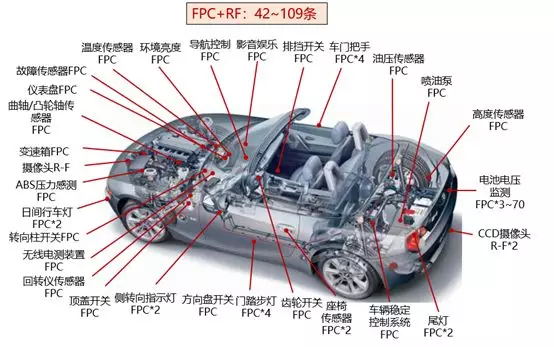
Source: iFixit, Zhanxin PCB Industry Research Institute
More importantly, the use of PCB in new energy vehicles will be 5-8 times that of traditional vehicles, and the penetration of new energy vehicles will increase rapidly in the automotive PCB market.
Global market scale of FPC for automobiles
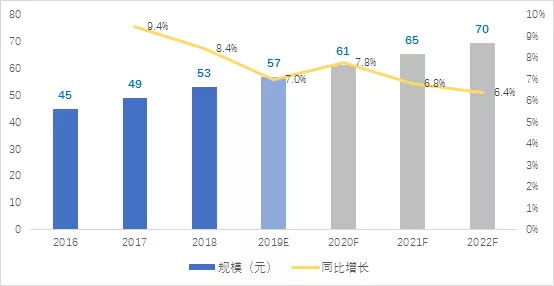
According to the statistics of Zhanxin PCB Industry Research Institute, in 2018, the market of flexible circuit boards (FPC) for automobiles reached 5.3 billion yuan, an increase of 8.4% over the same period of last year. The main driving force of the market growth is the improvement of the degree of automobile electronization and the penetration of new energy vehicles. The global market is expected to reach 5.7 billion yuan in 2019, an increase of 7.0% over the previous year. From 2016 to 2022, the annual growth rate of automotive FPC will remain between 6% and 9%, and the market size of automotive FPC will grow to 7 billion yuan by 2022.
Global Automotive FPC Market Scale and Forecast in 2016-2022
Data Source: Zhanxin PCB Industry Research Institute
In 2018, global sales of electric vehicles exceeded the 2 million mark, reaching 2.08 million, up 65% compared with 2017, and their share of global automobile sales rose to 2.1%. Global production of electric vehicles is expected to exceed 3 million units in 2019.
According to the data of China Automobile Industry Association, in 2018, domestic production and sales of new energy vehicles reached 1.27 million and 1.256 million respectively, increasing by 59.9% and 61.7% respectively. Among them, 986,000 and 984,000 pure electric vehicles were produced and sold, respectively, up 47.9% and 50.8% over the same period last year. The production and sales of plug-in hybrid electric vehicles reached 283,000 and 271,000 respectively, up 122% and 118% respectively from the same period last year. From January to June 2019, the sales of new energy passenger cars reached 570,000 units, an increase of 65% over the same period last year.