The Potential of PCB in the Future: SLP Technology
As the largest proportion of all kinds of consumer electronic products, mobile phone's demand for PCB can most influence the development prospects of PCB industry.
At present, the mobile phone market has gradually entered saturation, so the growth mode of mobile phone brand factories is only to divide up the market share between them. In the smartphone market in the first half of 2019, according to the data released by IDC, the global smartphone shipments reached 333 million units, which decreased by 2.3% annually. Among them, Samsung, Huawei and Apple ranked in the top three with 22.7%, 17.6% and 10.1% market share respectively.
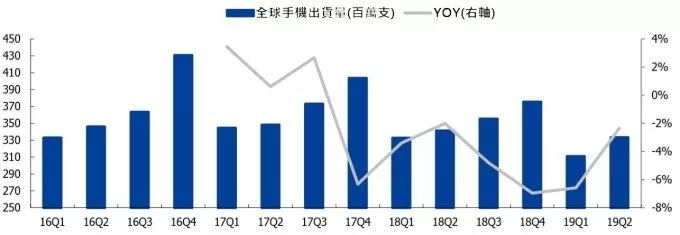
Global mobile phone shipments
The prolonged switching cycle of consumers has led to a slump in demand for smartphones, mainly due to:
- Limited innovation: The speed of innovation in smartphone hardware can not catch up with the rise in smartphone prices, resulting in low consumer interest in flagship smartphone.
- Longer life: The software system of smartphones is constantly strengthened, and major brands regularly improve and upgrade the system, making the service life of mobile phones longer.
- Wait and see 5G: Because the major brand factories are laying out 5G, seizing the first chance, but the telecommunications hardware infrastructure is still insufficient, leading to consumers are still on the wait-and-see state. 5G: Because the major brand factories are laying out 5G, seizing the first chance, but the telecommunications hardware infrastructure is still insufficient, leading to consumers are still on the wait-and-see state.
However, with the construction of 5G base station reaching a certain scale, the smartphone market pattern will change. The arrival of 5G will completely subvert the network performance of mobile phones in the 4G era, and will attract consumers'demand for switching.
According to Strategy Analytics, the shipment of 5G smartphones will increase from 2 million in 2009 to 1.5 billion in 2025, with a compound annual growth rate of 201%.
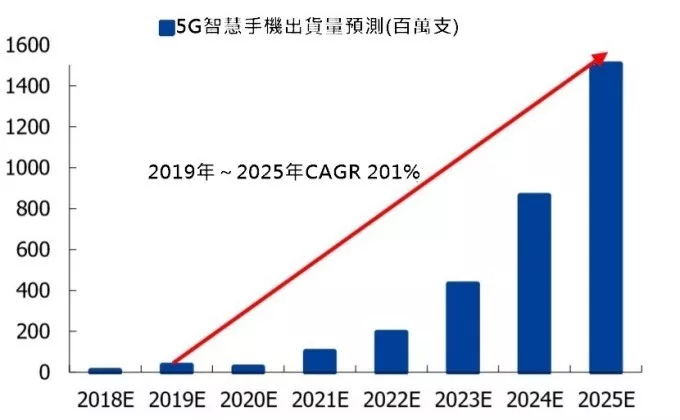
Forecast of 5G Smart Phone Shipment
Nowadays, the development of mobile phones is becoming more and more intelligent and lightweight, which means that the internal components of mobile phones will be further reduced or integrated. Under this development trend, both FPC(flexible printed circuit board) and SLP in PCB have the opportunity to be further promoted and applied.
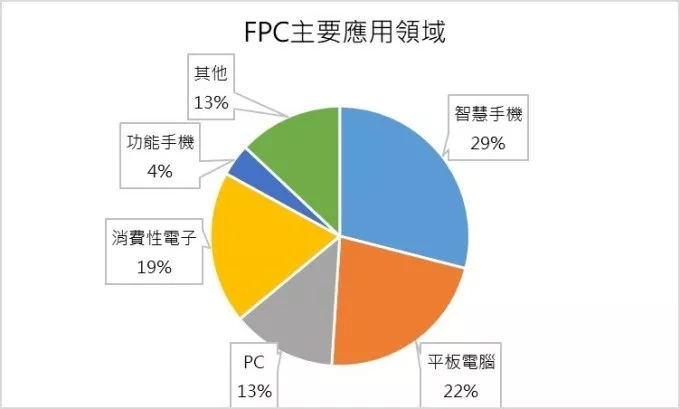
Main Application Areas of FPC
According to the data in 2018, the global PCB output value reached 63.5 billion US dollars, and the FPC output value rose to 12.7 billion US dollars, becoming a relatively fast-growing project in the PCB industry, while China's FPC market accounted for about half of the global market.
At present, the scale of FPC in China has grown to RMB 31.6 billion yuan. It is estimated that by 2021, China's FPC market will have an opportunity to reach RMB 51.6 billion yuan, with an annual compound growth rate of 10%.
Nowadays, the use of FPC for smartphones of mainstream Chinese brands ranges from 10 to 15, while the use of iPhone X is as high as 20 to 22. It can be seen that the use of FPC in smartphones in China still has a lot of space for improvement. At the same time, the single value of FPC has reached $10, and the amount is still rising.
FPC is widely used in smartphones to connect parts and motherboards, such as display module, fingerprint module, lens module, antenna, vibrator and so on. With the penetration of fingerprint recognition, the shift of lens from double lens to three lens, and the use of OLED, the use of FPC will continue to increase.
The highest PCB process: SLP
With the development of smart phones from 4G LTE to 5G, the configuration of Massive MIMO antenna is becoming more and more complex, which also makes the RF front end occupy more space in 5G smart phones. In addition, the volume of data processed by 5G system will grow geometrically, which will increase the requirement of battery capacity, which means that PCB and other electronic components must be compressed to complete packaging in a more dense and smaller form.
This evolution pushes PCB HDI technology towards thinner, smaller and more complex processes. In recent mobile phone designs, the minimum linewidth/spacing requirement has been reduced from 50 microns in previous generations to 30 microns at present, which has led to the development of technology similar to carrier plate (SLP).
Leading this technology trend is Apple. Starting with the iPhone 8 and the iPhone X, the iPhone uses SLP technology with smaller line width and spacing, leading the HDI market towards the development of the class board.
Although the SLP market is currently over-reliant on the growth of high-end smartphones, especially the Apple iPhone and the Samsung Galaxy series. However, in March 2019, after Huawei launched the P30 Pro with SLP technology, it is expected that SLP technology will grow to 2024 in the future with the follow-up adoption of mobile phone manufacturers around the world.
In addition, with the increasing number of OEM manufacturers using SLP, mobile phone manufacturers are planning to use SLP in other consumer electronics products such as smart watches and tablets, which will obviously drive the growth of SLP market.
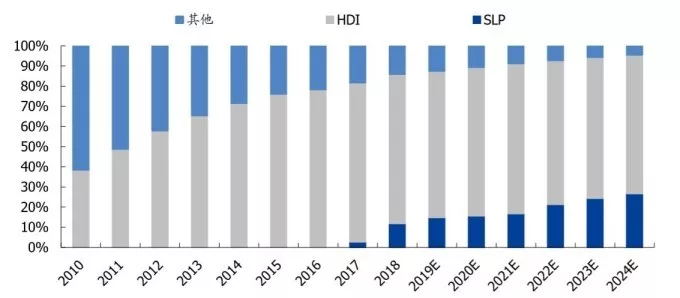
Global Cell Phone PCB Process Output Ratio
According to Yole, in 2018, the global SLP market was $987 million. In 2018, SLP technology accounted for only about 7% of global mobile phone shipments, while the corresponding output value accounted for about 12%. Yole predicts that by 2024, the proportion of mobile phone shipments using SLP technology will increase to 16%, and the corresponding proportion of output value will be about 27%.
In terms of production technology, SLP technology is currently dominated by Taiwan, Korea and Japan. Japanese companies such as Meiko and Junding are expanding SLP production lines to Vietnam and mainland China. With the technology transfer, PCB factories in mainland China will gradually master SLP technology know-how.
Due to the higher frequency of 5G, more stringent impedance control is needed. Without extremely precise shaping, thinner HDI lines may increase the risk of signal attenuation and reduce data transmission integrity. At present, PCB manufacturers mainly solve this problem through MSAP manufacturing.
Today's line width/spacing requirements have been reduced to 30/30µm, and are expected to be further reduced to 25/25µm, or even 20/20µm. The MSAP process can fully support these requirements.
Meanwhile, the SLP value of MSAP process is more than twice that of high-level Anylayer, which can bring abundant profits to relevant manufacturers.
Compared with the past, the advanced carrier board market has undergone tremendous changes. The development of high density fan-out (HDFO) technology and the continuous reduction of IC carrier size will reduce the demand for carrier. However, although in terms of quantity, the future PCB market will not show too obvious growth, but the added value brought by new technology will be the main force to boost PCB output value.