Re-interpretation of High Speed PCB
What is a high-speed circuit?
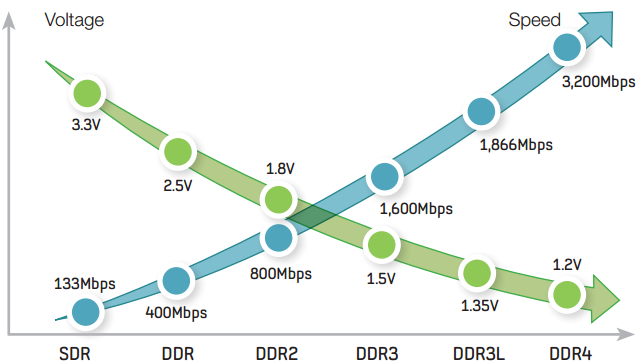
In the past low-speed era, when the level jumps, the signal rises for a long time, usually with several ns. The interconnection between devices will not affect the function of the circuit, so it is unnecessary to care about the signal integrity. But in today's high-speed era, with the increase of IC output switching speed, many of them are in picosecond level. Regardless of the signal cycle, almost all designs have encountered signal integrity problems. In addition, the pursuit of low power makes the internal nuclear voltage lower and lower, and the internal nuclear voltage of DDR 41.2v is very common. Therefore, the system can tolerate less and less noise margin, which also makes the signal integrity problem more prominent.
The root cause of signal integrity problem is the decrease of signal rise time. Even if the routing topology remains unchanged, if IC chips with small signal rise time are used, the existing design will be in a critical state or stop working at all.
1. Definition of High Speed Circuit
In a narrow sense, it is generally believed that the frequency of a digital logic circuit reaches or exceeds 50MHz, and that the circuit operating above this frequency has already accounted for a considerable proportion of the entire electronic system, such as one third, which is called a high-speed circuit.
In fact, the harmonic frequency of the signal edge is higher than that of the signal itself. It is the rising and falling edges of the signal that cause various problems of signal transmission.
Therefore, when the length of the transmission path of the signal is greater than 1/6 times the wavelength of the transmission signal, the signal is considered as a high-speed signal; when the signal propagates along the transmission line, it is considered as a high-speed signal when serious skin effect and ionization loss occur.
Therefore, it is generally agreed that if the propagation delay of the signal on the circuit board is greater than half of the rise time of the digital signal driver, such a signal is considered as a high-speed signal and produces transmission line effect, such a circuit is a high-speed circuit.
2. The difference between high-speed PCB and high-frequency PCB
Most of the signal integrity books introduce the two basic concepts of high speed and high frequency before studying the signal integrity. From this point, we can know the importance of distinguishing the two concepts.
Because, through these two concepts, we can identify the object of signal integrity analysis. For the concept of high frequency is relatively simple to understand, it is only a description of frequency, as you know, frequency is the reciprocal of the cycle, high frequency is the expression of high frequency, short period.
Speaking of the concept of high speed, we return to the concept of speed. Speed is a physical quantity representing the speed of motion. In physics, it is the differential of displacement to time, which is also called dS/dt.
Similarly, it can be used in circuit to refer to the differential of potential shift to time, which is characterized by the speed of voltage change, that is, dV/dt, which is usually expressed as rise time. Therefore, high-speed circuit is the expression of fast voltage change and short rise time. In the circuit system, the rise time has a great influence on the signal integrity, which is also the root of the problem of signal integrity. So that signal integrity analysis is basically based on dV / dt analysis and discussion, rather than for the period, which is the essential difference between high-speed and high-frequency.
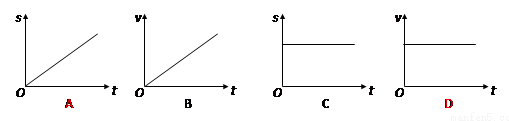
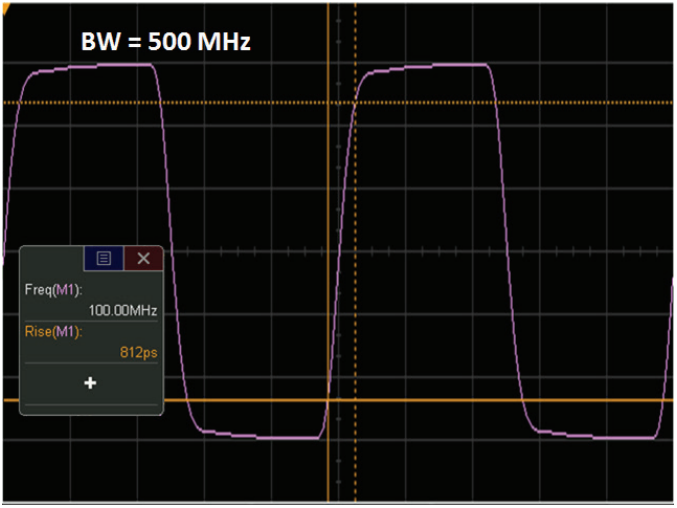
Therefore, from the above description of the two concepts, we can see that high frequency and high speed are not directly related. There are several positive and negative examples. For example, when a clock signal has a frequency of 50 MHz and a rise time of 90 ps, it is not a high-frequency signal, but it is a high-speed signal, that is, the frequency is not high, but the rise edge is fast. For example, if the frequency is 500 MHz and the rise time is 0.8 ns, the frequency is much higher than that of the signal in the preceding example, but the speed is much lower than that of the signal in the preceding example. So, we say that there is no relationship between high frequency and high speed.
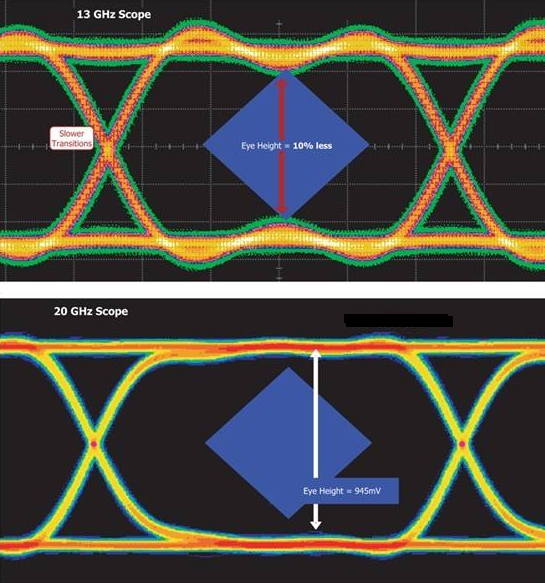
From another point of view, does high speed really have nothing to do with high frequency?
In fact, people often confuse these two concepts because they are inextricably linked.
Specifically, as the frequency increases, the period decreases. As a result, we must increase the speed. The reason is that we must ensure sufficient setup time and retention time.
With the compression of the period, if we want to have enough setup time and holding time, we can only shorten the rising time and falling time to meet the requirements of the timing effectiveness of the signal.
Take chestnut for example, the frequency of a signal is 100 MHz, that is, the period is 10 ns, the rising time and the falling time are 1 ns respectively, so that the effective sampling time window of the signal is (10-1) ns, that is, 8 ns.
If the frequency of this signal is increased to 200 MHz and the rising time and the falling time remain unchanged, the sampling window will become (5-1-1) = 3ns, and with the increasing frequency, the sampling window will continue to decrease. In extreme cases, it will lead to incorrect sampling, which will force the rising time and falling time to decrease. To meet the increasing sampling clock frequency.
To sum up, that is to say, the increase of frequency necessarily forces the increase of speed. The evolution of high-frequency circuit leads to high-speed circuit. It is a sufficient condition, not a necessary condition, between high-frequency and high-speed. In addition, in the process of signal integrity analysis, high-speed circuits are generally emphasized.